
Estoy por apuntarme al keyflower. Así soy yo. Si me apunto sería para, lógicamente, ganar por paliza.
Esta sección te permite ver todos los mensajes escritos por este usuario. Ten en cuenta que sólo puedes ver los mensajes escritos en zonas a las que tienes acceso en este momento.
#4846
Madrid / Re:Quedada Gen X Puebla (19/05/2015) ¿The Queen is dead?
19 de Mayo de 2015, 11:11:00 #4847
Podcasts / [El Tablero] Programa ET93: Desde la Torre, Obama nos vigila
19 de Mayo de 2015, 10:57:24
#4848
Reseñas escritas / The Battle at Kemble's Cascade (Primeras impresiones)
19 de Mayo de 2015, 09:54:59
Trasladar un video-juego a un juego de mesa es algo que parece bastante complicado. Sobre todo porque tanto las capacidades que requieren unos y otros como la experiencia de juego que te ofrecen no pueden ser las mismas, y eso puede generar espectativas que no se cumplan.
Teniendo esto muy en cuenta, este The Battle at Kemble's Cascade (TBaKC) supone un muy buen juego de tablero que traslada en gran parte la experiencia de esos videojuegos "de scroll" ochenteros y noventeros de naves.


Este TBaKC, un juego diseñado por Anders Tyrland y Olle Tyrland, publicado por Z-Man, recomendado para de 2 a 5 jugadores (aunque parece que existe variante para 1 jugador, que yo no he probado) y uan duración de unos 75-90 minutos, creo que destaca por dos elementos:
1) El original "tablero de juego", que se construye a partir de unas "guías" o "railes" en los que se colocan las cartas/losetas que contienen los enemigos/obstáculos/espacios. Estas guías se distribuyen verticalmente y van "desapareciendo y apareciendo" en una simulación del fenómeno "scroll" de los citados videojuegos.


2) La "progresión" y personalización de tu nave, ya que durante la partidas podrás (necesitarás sería más correcto) mejorar tu nave consiguiendo mejor desplazamiento, nuevas armas o defensa extra.
Una de las cosas que me gusta es que no puedes adquirir "todas" las mejoras disponibles y debes centrarte en algunas de ellas y desarrollarlas. Por ejemplo, cada nueva arma ( aquí abajo tenéis un ejemplo) puede ser mejorada hasta alcanzar nivel tres. Debes pensarte muy bien cual de ellas quieres adquirir y mejorar.

El modo de juego es sencillo y ágil a la vez que inmersivo: tienes básicamente dos opciones
1) Activarte, lo que implica desplazarte y atacar. Puedes, con una mecánica de "gestión de acciones", gastar energía para realizar más movimientos o acciones (no entro en detalle en la mecánica para no alargar la reseña innecesariamente).

Existen además unas sencillas mecánicas respecto a la orientación de la nave y a la pérdida añadida de energía (que tiene que ver con unos puntos de "amenaza" que acumulas al estar en la "zona de influencia" de los enemigos" y que tendrás que "purgar" gastando energía), que hacen que tengamos que pensar cómo "gestionamos" nuestra energía, movimiento y ataque para que el turno sea lo más óptimo posible.
2) Recargar energía y adquirir mejoras. Las mejoras se adquieren gastanto unos "cristales" (bellonium) que vamos consiguiendo al destruir las naves y amenazas que nos aparecen.
A esto debemos sumarle algunos elementos más:
a)Nuestra nave puede resultar "destruida" si pierde toda la energía, pero no somo eliminados del juego, sino que deberemos gastar nuestro próximo turno en reaparecer (y la energía con la que reaparecemos es variable, lo que implica que habrá momentos en los que quizá pueda resultar estratégicamente viable "inmolarse" para reaparecer posteriomente).
b)Podemos disparar al resto de naves, ya que el juego es competitivo: ganará, tras acabar con todas las amenazas y un jefe de final de pantalla

quien acumule más puntos de victoria (de gloria o fama creo que les han llamado). ¿Y como se consiguen esos puntos de gloria? De una forma también muy interesante: mediante misiones, de las cuales cada jugador tiene una personal (p.e. permanecer en el lugar más "extremo" del tablero durante un número de fases), y existen otras comunes (p.e. ser el primero en conseguir x mejoras, o en destruir en un mismo turno tres amenazas), y también cada vez que otro jugador es destruido (no eliminado, recordad).
c) El juego incluye una "subasta" al inicio de turno que marcará el orden de turno de juego (y quizá algún bonus), lo que aporta otro elemento táctico al juego.
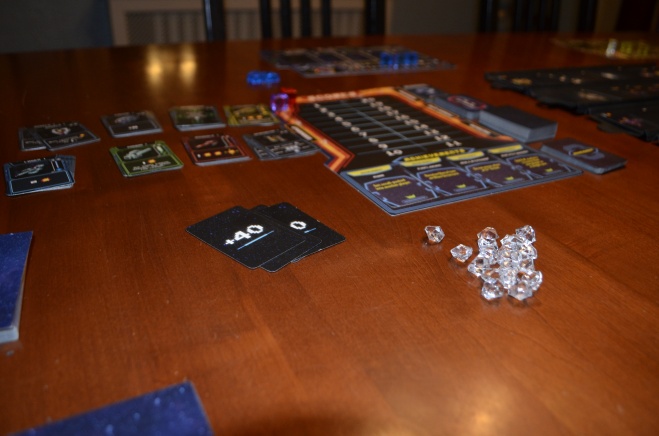
d) Posibilidad de incluir variantes. Tanto en la configuración de la partida (distintas dificultades, distintas "pantallas", enemigos especiales o nuevos elementos, como el mosquito espacial o el comerciante) como en modos de juego: en solitario, por equipos o todos contra todos.
Todo consigue, en mi opinión, una interesantísima mezcla entre juego temático y de gestión de acciones, muy recomendable no solo por la curiosa ambientación pixelada, sino por lo ágil, táctico e inmersivo que resulta.
El principal handicap puede ser que, pese a la baja dependencia de idioma de los componentes, no se encuentra traducido al castellano, y creo que tampoco circula una traducción amateur por los "canales habituales".
Ustedes lo juegen bien.
#4849
Variantes / Re:A Study in Emerald: diferencias entre 1ª y 2ª edición.
19 de Mayo de 2015, 09:01:36Cita de: lostrikis en 18 de Mayo de 2015, 20:27:31
No hay agentes dobles... ni lo comento.
Los discos de bloqueo me encantan. Guardarte esa maravillosa carta para ver como tu rival se pega 3 turnos para coger una carta/ciudad y bloqueársela cuando acaba de jugar su carta de bloqueo mola mucho.
En el primer elemento tengo sensaciones contradictorias: por una parte, es muy interesante poder "robar" agentes a otros jugadores. Por otra, introducía un azar de los que dejan a veces mala sensación (cuando tú no puedes robar ningún agente de nadie porque no salen, y a ti te quitan todos).
Lo de no poder bloquear/robar ciudades a otros jugadores me resulta una pérdida importante.
Veremos a ver cuanto se resiente la experiencia de juego.
#4850
Novedades / Actualidad / Re:Ediciones MasQueOca editará Study in Emerald en Español
19 de Mayo de 2015, 08:44:34Cita de: Stuka en 19 de Mayo de 2015, 01:03:25
¿Alguien puede arrojar un poco de luz sobre el juego en sí?
Quiero decir que para mi es un juego desconocido y me gustaría saber porqué es tan bueno.
(Aunque juego a casi cualquier cosa provengo de los wargames, con eso ya lo he dicho todo).
Ampliando lo que comenta JGGarrido, el juego original propicia grandes partidas en una condiciones determinadas (una mesa con jugadores con sufiente "picardía" y conocimiento del juego) ya que tiene dos o tres elementos bien diferenciados y relativamente originales:
1) En la primera parte de la partida el objetivo principal es "construir" tu mazo, y las cartas que van apareciendo generan cierta sensación de "mejora" y de "sorpresa", además de la tensión de quién se las queda (P.e. el enfrentamiento por quedarse con Yog-Sothogh, o por "la mano negra", o por Sherlock Holmes...). En esto los temas (Sherlock Holmes y mitos de Lovecraft) tienen mucho peso.
2) En la parte central del juego el principal objetivo es conocer o confirmar quién forma parte de tu bando (ya que la forma de puntuación y la mecánica de roles ocultos te obliga a asegurarte de que quien comparta alineamiento contigo no quede el último).
3) El final de la patida es un duelo intestino de mayorías por quedarse/quitar las ciudades, conseguir asesinar/salvar primigenios o subir/bajar los tracks de guerra/revolución (para eso último será decisorio el mazo que hayas conseguido construir), y cómo conseguir cerrar la partida en un momento en el que se conjugue que tú seas el mejor de tu bando y que nadie de tu bando sea el último.
En resumen, un juego con elementos muy originales, que ha conseguido entrelazar tres mecánicas: mayorías, deck building y roles ocultos.
EDITO: Teniendo esto en cuenta y por las modificaciones que conocemos de la 2ª edición, es posible que estos principales elemenos se respeten, por eso creo que esta 2ª edición también puede funcional. La duda que tenemos muchos es si va a resultar, al compararlos inevitablemente si ya has jugado a la 1ª edición, algo descafeinado.
#4851
Ayudadme a elegir: ¿Qué juego me compro? / Re:Juego de subastas, con algo de chicha
18 de Mayo de 2015, 23:25:50
Ofrandes tampoco funciona mal, donde la subasta es la mecánica central pero se entremezcla con otras.
#4852
Novedades / Actualidad / Re:Ediciones MasQueOca editará Study in Emerald en Español
18 de Mayo de 2015, 21:34:16Cita de: Tri2 en 18 de Mayo de 2015, 20:22:58
En cualquier caso, lo hayan casualizado o no, me parece que va a ser un 'take my money' de libro.
Se sabe por cuanto sale el preorder y por qué es tan caro? 😛
La primera edición es tan cara, en el mercado de 2ª mano, porque está descatalogada y no se prevée reedición (de esa versión), además de que se publicaron pocas copias.
#4853
Variantes / Re:A Study in Emerald: diferencias entre 1ª y 2ª edición.
18 de Mayo de 2015, 21:22:27Cita de: Alberto en 18 de Mayo de 2015, 17:26:18Cita de: calvo en 18 de Mayo de 2015, 17:23:09Creo recordar que eran 5 puntos de penalización. Lo que no sé es si eso es mucho o poco. Este cambio lo veo bien, que se te tenía que quedar una cara de tonto cuando haces la partida perfecta y otro de tu bando lo ha hecho fatal...
Más cosas: se oía comentar también que en esta revisión el bando con el jugador que menos puntos haya obtenido no "pierde" automáticamente, sino que recibe una penalización de una cantidad de puntos (que no conozco o no recuerdo).
Eso es una de las cosas magistrales del juego. Espantaba a los obsesos del control de la mesa, algo que muchos celebramos.
#4854
Dudas de Reglas / Re:Dead of Winter (Dudas)
18 de Mayo de 2015, 20:47:46Cita de: Thunderchild en 18 de Mayo de 2015, 19:35:38Cita de: banjoman en 18 de Mayo de 2015, 18:33:30
Si ,jugué con el lado difícil y sacar cuatro o mas es un 50% de posibilidades con lo cual es matar una media de 16 zombies y si te dedicas a eso que es tu objetivo en maximo tres turnos acabas . Y con 7 cartas cada uno es fácil curarte , no morir en los desplazamientos con gasolina y repetir dados con los trastos. Lo seguiré probando pero yo principalmente lo jugare a dos .
Cooperativo es medio aburrido el juego todo sea dicho, prueba la variante a 2 que propuso el autor original, de que cada uno roba una carta de traición y una carta normal y puede ganar por cualquiera de las dos
Por aquí te lo narran los chavales:
http://labsk.net/index.php?topic=138738.0
#4855
Chat / Re:A qué has jugado esta semana?
18 de Mayo de 2015, 20:37:13
Estoy a tope señores. ¿Alguien se anima esta tarde-noche?
#4856
Variantes / Re:A Study in Emerald: diferencias entre 1ª y 2ª edición.
18 de Mayo de 2015, 17:23:09
Más cosas: se oía comentar también que en esta revisión el bando con el jugador que menos puntos haya obtenido no "pierde" automáticamente, sino que recibe una penalización de una cantidad de puntos (que no conozco o no recuerdo).
#4857
Variantes / Re:A Study in Emerald: diferencias entre 1ª y 2ª edición.
18 de Mayo de 2015, 17:22:12Cita de: Lochi en 18 de Mayo de 2015, 17:03:38
Me llama la atención que en las cartas de identidad secreta lealista pone que si te matan ganas 3 agentes y sigues jugando... Sí que cambia mucho el tema de los agentes lo cual lo hace algo impersonal, ya no llevarás a Sherlock o a Moriarty

Tiene pinta de que los agentes sobre todo para lo que van a servir es para conseguir mayorías. Parece que solo se contará con 10 cubos, no se pueden "comprar" más (ya no hay "dinero"), y que con las cartas los pones o los quitas con acciones e iconos diferenciados. Eso hace que te tengas que pensar mucho más donde usas los cubos y que las mayorías lo sean con menor número de cubos. Por tanto los agentes cobran mucho peso.
Supongo, no obstante, que mantienen su utilidad como "guarda-espaldas" y como posibilitadores de asesinatos.
Yo hay cosas que no veo necesariamente malas, pero a ver como se terminan por resolver y qué sensaciones genera el juego.
#4858
Variantes / Re:A Study in Emerald: diferencias entre 1ª y 2ª edición.
18 de Mayo de 2015, 14:48:48
Corto y pego desde los hilos de la BGG donde se comenta cambios o posibles cambios, pero ojo porque creo que algunos de los comentarios están basados en los prototipos de la segunda edición:
Here's a rundown of the major changes Wallace seems to have in store for the 'streamlined' version. I would say radically streamlined.
First, what he doesn't mention:
*Last place faction losing mechanic. He makes no mention of whether this is still intact. It would be a travesty if this were eliminated, so hopefully he kept it.
* Secret identities.
He does mention that the secret identity concept is still there, but he does not mention any changes that would actually make this meaningful, e.g., the one quibble with the current game is that most actions are so obviously Restorationist or Loyalist that it's simple to discern everyone's identities with minimal effort.
* Permanent Effect Cards
No mention of these, but you get the sense that they're going away.
Now for what he DOES go into:
* More use of symbols on the cards. thumbsup If the card has the symbol on it you can use it for whatever that symbol means, if it doesn't have it you can't. So, evidently you will no longer have to pick between using coins, influence, or even bombs, because the cards will only have one option.
The intent is to reduce confusion about what you can and cannot do with the cards in your hand.
Symbols are a good thing, so I'm intrigued by this change, but for a different reason. One of the points of confusion in the current game is the cacophony of cards displayed on the board and not having an easy-on-the-eyes sense of what's out there. With clear, bright, symbols you'd be able to identify things like "Hide Royalty" at a glance. And this leads in to the next one...
* All new artwork.
His intent is to make the board itself and the cards more clear and intuitive, which is commendable.
I'm mixed on this. While I think clarity should override atmosphere, I happen to love the current artwork and kinda wince at the idea of a wholesale redo.
Simply redoing the cards to include more icons would have been a 100% improvement, IMO. It would also make the original game owners happy if they could just purchase the new cards and play on their old board, but it looks like he wants us to buy the whole shebang all over again. soblue And worse still, anyone wanting to play the original version will be SOL unless they can find a rare ($$$) copy.
* Victory points cannot be taken away during the game, including city cards. So if you capture London, both the card and the 6 VP are yours forever!
In fact, the only time points are ever reduced is during final scoring, after the game has ended and color loyalties are revealed.
I don't like this at all. The ability to negate points is a key part of the strategic depth, IMO, and to eliminate that would seem to just make it a race. But more importantly, it dramatically affects the last place losing faction mechanic, which makes me wonder whether that was retained or not.
* No more coins.
He doesn't say how new influence cubes will be 'purchased' from your supply, but evidently it will not be with money. Will you spend influence icons to 'purchase' new cubes? Also, this leads into the next change...
* No more links between cities. Movement will be done with a "rail" icon on cards.
His intent is to simplify movement on the board. Evidently instead of using coins to travel between cities, you will have a "rail" icon that allows you to "move anywhere." I assume this means you can move to any adjacent city, but it could mean literally "anywhere."
I like the idea of a rail icon. I'm not sure what to think of this except to say that I personally didn't find the current system of coins and links between cities to be flawed. If any simplification needed to be done to make movement easier, simply making each link between cities cost just one coin would have done the trick. If you are going to have a rail icon then the links should simply be railroad tracks between the cities with one rail icon required for each additional track you have to travel. But what about traveling from London to Washington? Will there also be a ship icon for coastal travel?
* Assassinations simplified by eliminating the distinction between AA/AR. It will now just be Assassin listed on the cards (I assume an assassin symbol?) and it means you can assassinate an agent and/or a royal.
I actually like this change. It makes sense.
* Agents are now generic with no counters.
I'm not sure what he means by this, but my take is that all the distinctive abilities agents have in the current game is going away and each will now just have a standard ability. Again, not really clear, but I hope this is not the case!
With these and other changes, it's fairly clear that this game will be completely different; so much so, in fact, it should probably be called something besides A Study in Emerald.
I got to play the prototype of ASiE v2 with Martin Wallace at PAX Aus on Sunday and was able to find out quite a bit about the new version:
(I'll share what I can without explicitly explaining mechanics, because I'm sure some will change, and the game is still far from release)
* The aim with the redux is to reposition the game as a more mass-market version of the game, with the hope of appealing to not just the hardcore boardgamers, but also Neil Gaiman fans, Holmes fans and people into Cthulhu
* As such, the game has been stripped down to the core elements - still a deckbuilder, still with bidding for influence. The semi-teamwork idea has been retained but tweaked to be less fiddly on scoring, and less punishing for the team with the last place player. (Losing team lose vps, instead of wholesale elimination.)
* The deckbuilding is now even more a central element of the game. In our session, Martin brutalised us with some very canny card acquisitions.
* Permanent effects have been absorbed into the main market of cards as normal cards.
* Agents have been massively simplified to make them quicker to get to the board, more effective, easier to move and, most importantly:
* Assassinations has been massively simplified, but still retaining some of the nuance and limitations of the original. ASiE Redux is a much livelier game on that front.
* Sanity can go very quickly for Restorationists, perhaps a little too much so - I'd like to see a few more opportunities to improve sanity.
All this adds up to a much faster game (I think we were done in about 30 -40 mins) that should be infinitely easier to teach as well. It doesn't really replace the original, but stands alongside it. Martin also told us that there won't be any easy way to convert the original as the new version is too different and I'm inclined to agree. As ASiE v2 will be aimed at mass market, it should also be cheaper than the original, and if this is the case, I'll be quite comfortable buying it when it pops up. In the meantime, it's given me some ideas to do a 'beginners game' variant of the original to make teaching it a little easier.
The bad news is that with the new one on the way, the original will not be reprinted, so snap them up while they're out in the wild.
Here's a rundown of the major changes Wallace seems to have in store for the 'streamlined' version. I would say radically streamlined.
First, what he doesn't mention:
*Last place faction losing mechanic. He makes no mention of whether this is still intact. It would be a travesty if this were eliminated, so hopefully he kept it.
* Secret identities.
He does mention that the secret identity concept is still there, but he does not mention any changes that would actually make this meaningful, e.g., the one quibble with the current game is that most actions are so obviously Restorationist or Loyalist that it's simple to discern everyone's identities with minimal effort.
* Permanent Effect Cards
No mention of these, but you get the sense that they're going away.
Now for what he DOES go into:
* More use of symbols on the cards. thumbsup If the card has the symbol on it you can use it for whatever that symbol means, if it doesn't have it you can't. So, evidently you will no longer have to pick between using coins, influence, or even bombs, because the cards will only have one option.
The intent is to reduce confusion about what you can and cannot do with the cards in your hand.
Symbols are a good thing, so I'm intrigued by this change, but for a different reason. One of the points of confusion in the current game is the cacophony of cards displayed on the board and not having an easy-on-the-eyes sense of what's out there. With clear, bright, symbols you'd be able to identify things like "Hide Royalty" at a glance. And this leads in to the next one...
* All new artwork.
His intent is to make the board itself and the cards more clear and intuitive, which is commendable.
I'm mixed on this. While I think clarity should override atmosphere, I happen to love the current artwork and kinda wince at the idea of a wholesale redo.
Simply redoing the cards to include more icons would have been a 100% improvement, IMO. It would also make the original game owners happy if they could just purchase the new cards and play on their old board, but it looks like he wants us to buy the whole shebang all over again. soblue And worse still, anyone wanting to play the original version will be SOL unless they can find a rare ($$$) copy.
* Victory points cannot be taken away during the game, including city cards. So if you capture London, both the card and the 6 VP are yours forever!
In fact, the only time points are ever reduced is during final scoring, after the game has ended and color loyalties are revealed.
I don't like this at all. The ability to negate points is a key part of the strategic depth, IMO, and to eliminate that would seem to just make it a race. But more importantly, it dramatically affects the last place losing faction mechanic, which makes me wonder whether that was retained or not.
* No more coins.
He doesn't say how new influence cubes will be 'purchased' from your supply, but evidently it will not be with money. Will you spend influence icons to 'purchase' new cubes? Also, this leads into the next change...
* No more links between cities. Movement will be done with a "rail" icon on cards.
His intent is to simplify movement on the board. Evidently instead of using coins to travel between cities, you will have a "rail" icon that allows you to "move anywhere." I assume this means you can move to any adjacent city, but it could mean literally "anywhere."
I like the idea of a rail icon. I'm not sure what to think of this except to say that I personally didn't find the current system of coins and links between cities to be flawed. If any simplification needed to be done to make movement easier, simply making each link between cities cost just one coin would have done the trick. If you are going to have a rail icon then the links should simply be railroad tracks between the cities with one rail icon required for each additional track you have to travel. But what about traveling from London to Washington? Will there also be a ship icon for coastal travel?
* Assassinations simplified by eliminating the distinction between AA/AR. It will now just be Assassin listed on the cards (I assume an assassin symbol?) and it means you can assassinate an agent and/or a royal.
I actually like this change. It makes sense.
* Agents are now generic with no counters.
I'm not sure what he means by this, but my take is that all the distinctive abilities agents have in the current game is going away and each will now just have a standard ability. Again, not really clear, but I hope this is not the case!
With these and other changes, it's fairly clear that this game will be completely different; so much so, in fact, it should probably be called something besides A Study in Emerald.
I got to play the prototype of ASiE v2 with Martin Wallace at PAX Aus on Sunday and was able to find out quite a bit about the new version:
(I'll share what I can without explicitly explaining mechanics, because I'm sure some will change, and the game is still far from release)
* The aim with the redux is to reposition the game as a more mass-market version of the game, with the hope of appealing to not just the hardcore boardgamers, but also Neil Gaiman fans, Holmes fans and people into Cthulhu
* As such, the game has been stripped down to the core elements - still a deckbuilder, still with bidding for influence. The semi-teamwork idea has been retained but tweaked to be less fiddly on scoring, and less punishing for the team with the last place player. (Losing team lose vps, instead of wholesale elimination.)
* The deckbuilding is now even more a central element of the game. In our session, Martin brutalised us with some very canny card acquisitions.
* Permanent effects have been absorbed into the main market of cards as normal cards.
* Agents have been massively simplified to make them quicker to get to the board, more effective, easier to move and, most importantly:
* Assassinations has been massively simplified, but still retaining some of the nuance and limitations of the original. ASiE Redux is a much livelier game on that front.
* Sanity can go very quickly for Restorationists, perhaps a little too much so - I'd like to see a few more opportunities to improve sanity.
All this adds up to a much faster game (I think we were done in about 30 -40 mins) that should be infinitely easier to teach as well. It doesn't really replace the original, but stands alongside it. Martin also told us that there won't be any easy way to convert the original as the new version is too different and I'm inclined to agree. As ASiE v2 will be aimed at mass market, it should also be cheaper than the original, and if this is the case, I'll be quite comfortable buying it when it pops up. In the meantime, it's given me some ideas to do a 'beginners game' variant of the original to make teaching it a little easier.
The bad news is that with the new one on the way, the original will not be reprinted, so snap them up while they're out in the wild.
#4859
Novedades / Actualidad / Re:Ediciones MasQueOca editará Study in Emerald
18 de Mayo de 2015, 14:45:49Cita de: JGGarrido en 18 de Mayo de 2015, 12:24:18Cita de: calvo en 18 de Mayo de 2015, 12:22:27Perfecto calvo, pues cuando comente las diferencias tras leer las reglas de esta nueva edición las pondré por ahí.
Estamos comentando por aquí las diferencias entre versiones:
http://labsk.net/index.php?topic=154647.0
En algunos hilos de la BGG se van filtrando cosas, entiendo que de los prototipos, y de las imágenes que se han publicado en la web se pueden intuir cosillas, pero si nos puedes ir comentado cosas sería lo suyazo

ejemplos (movido al hilo en el que hablamos de las diferencias entre versiones). http://labsk.net/index.php?topic=154647.msg1454766#msg1454766
Spoiler
Here's a rundown of the major changes Wallace seems to have in store for the 'streamlined' version. I would say radically streamlined.
First, what he doesn't mention:
*Last place faction losing mechanic. He makes no mention of whether this is still intact. It would be a travesty if this were eliminated, so hopefully he kept it.
* Secret identities.
He does mention that the secret identity concept is still there, but he does not mention any changes that would actually make this meaningful, e.g., the one quibble with the current game is that most actions are so obviously Restorationist or Loyalist that it's simple to discern everyone's identities with minimal effort.
* Permanent Effect Cards
No mention of these, but you get the sense that they're going away.
Now for what he DOES go into:
* More use of symbols on the cards. thumbsup If the card has the symbol on it you can use it for whatever that symbol means, if it doesn't have it you can't. So, evidently you will no longer have to pick between using coins, influence, or even bombs, because the cards will only have one option.
The intent is to reduce confusion about what you can and cannot do with the cards in your hand.
Symbols are a good thing, so I'm intrigued by this change, but for a different reason. One of the points of confusion in the current game is the cacophony of cards displayed on the board and not having an easy-on-the-eyes sense of what's out there. With clear, bright, symbols you'd be able to identify things like "Hide Royalty" at a glance. And this leads in to the next one...
* All new artwork.
His intent is to make the board itself and the cards more clear and intuitive, which is commendable.
I'm mixed on this. While I think clarity should override atmosphere, I happen to love the current artwork and kinda wince at the idea of a wholesale redo.
Simply redoing the cards to include more icons would have been a 100% improvement, IMO. It would also make the original game owners happy if they could just purchase the new cards and play on their old board, but it looks like he wants us to buy the whole shebang all over again. soblue And worse still, anyone wanting to play the original version will be SOL unless they can find a rare ($$$) copy.
* Victory points cannot be taken away during the game, including city cards. So if you capture London, both the card and the 6 VP are yours forever!
In fact, the only time points are ever reduced is during final scoring, after the game has ended and color loyalties are revealed.
I don't like this at all. The ability to negate points is a key part of the strategic depth, IMO, and to eliminate that would seem to just make it a race. But more importantly, it dramatically affects the last place losing faction mechanic, which makes me wonder whether that was retained or not.
* No more coins.
He doesn't say how new influence cubes will be 'purchased' from your supply, but evidently it will not be with money. Will you spend influence icons to 'purchase' new cubes? Also, this leads into the next change...
* No more links between cities. Movement will be done with a "rail" icon on cards.
His intent is to simplify movement on the board. Evidently instead of using coins to travel between cities, you will have a "rail" icon that allows you to "move anywhere." I assume this means you can move to any adjacent city, but it could mean literally "anywhere."
I like the idea of a rail icon. I'm not sure what to think of this except to say that I personally didn't find the current system of coins and links between cities to be flawed. If any simplification needed to be done to make movement easier, simply making each link between cities cost just one coin would have done the trick. If you are going to have a rail icon then the links should simply be railroad tracks between the cities with one rail icon required for each additional track you have to travel. But what about traveling from London to Washington? Will there also be a ship icon for coastal travel?
* Assassinations simplified by eliminating the distinction between AA/AR. It will now just be Assassin listed on the cards (I assume an assassin symbol?) and it means you can assassinate an agent and/or a royal.
I actually like this change. It makes sense.
* Agents are now generic with no counters.
I'm not sure what he means by this, but my take is that all the distinctive abilities agents have in the current game is going away and each will now just have a standard ability. Again, not really clear, but I hope this is not the case!
With these and other changes, it's fairly clear that this game will be completely different; so much so, in fact, it should probably be called something besides A Study in Emerald.
I got to play the prototype of ASiE v2 with Martin Wallace at PAX Aus on Sunday and was able to find out quite a bit about the new version:
(I'll share what I can without explicitly explaining mechanics, because I'm sure some will change, and the game is still far from release)
* The aim with the redux is to reposition the game as a more mass-market version of the game, with the hope of appealing to not just the hardcore boardgamers, but also Neil Gaiman fans, Holmes fans and people into Cthulhu
* As such, the game has been stripped down to the core elements - still a deckbuilder, still with bidding for influence. The semi-teamwork idea has been retained but tweaked to be less fiddly on scoring, and less punishing for the team with the last place player. (Losing team lose vps, instead of wholesale elimination.)
* The deckbuilding is now even more a central element of the game. In our session, Martin brutalised us with some very canny card acquisitions.
* Permanent effects have been absorbed into the main market of cards as normal cards.
* Agents have been massively simplified to make them quicker to get to the board, more effective, easier to move and, most importantly:
* Assassinations has been massively simplified, but still retaining some of the nuance and limitations of the original. ASiE Redux is a much livelier game on that front.
* Sanity can go very quickly for Restorationists, perhaps a little too much so - I'd like to see a few more opportunities to improve sanity.
All this adds up to a much faster game (I think we were done in about 30 -40 mins) that should be infinitely easier to teach as well. It doesn't really replace the original, but stands alongside it. Martin also told us that there won't be any easy way to convert the original as the new version is too different and I'm inclined to agree. As ASiE v2 will be aimed at mass market, it should also be cheaper than the original, and if this is the case, I'll be quite comfortable buying it when it pops up. In the meantime, it's given me some ideas to do a 'beginners game' variant of the original to make teaching it a little easier.
The bad news is that with the new one on the way, the original will not be reprinted, so snap them up while they're out in the wild.
#4860
Variantes / Re:A Study in Emerald: diferencias entre 1ª y 2ª edición.
18 de Mayo de 2015, 14:29:58Cita de: ushikai en 18 de Mayo de 2015, 12:57:14
Creo que nadie lo ha comentado pero veo cartas de vampiros y zombies, en su día se habló de que igual se quitaban, pues no, aquí siguen, viva!
Siguen ahí, pero más muertos que nunca

